
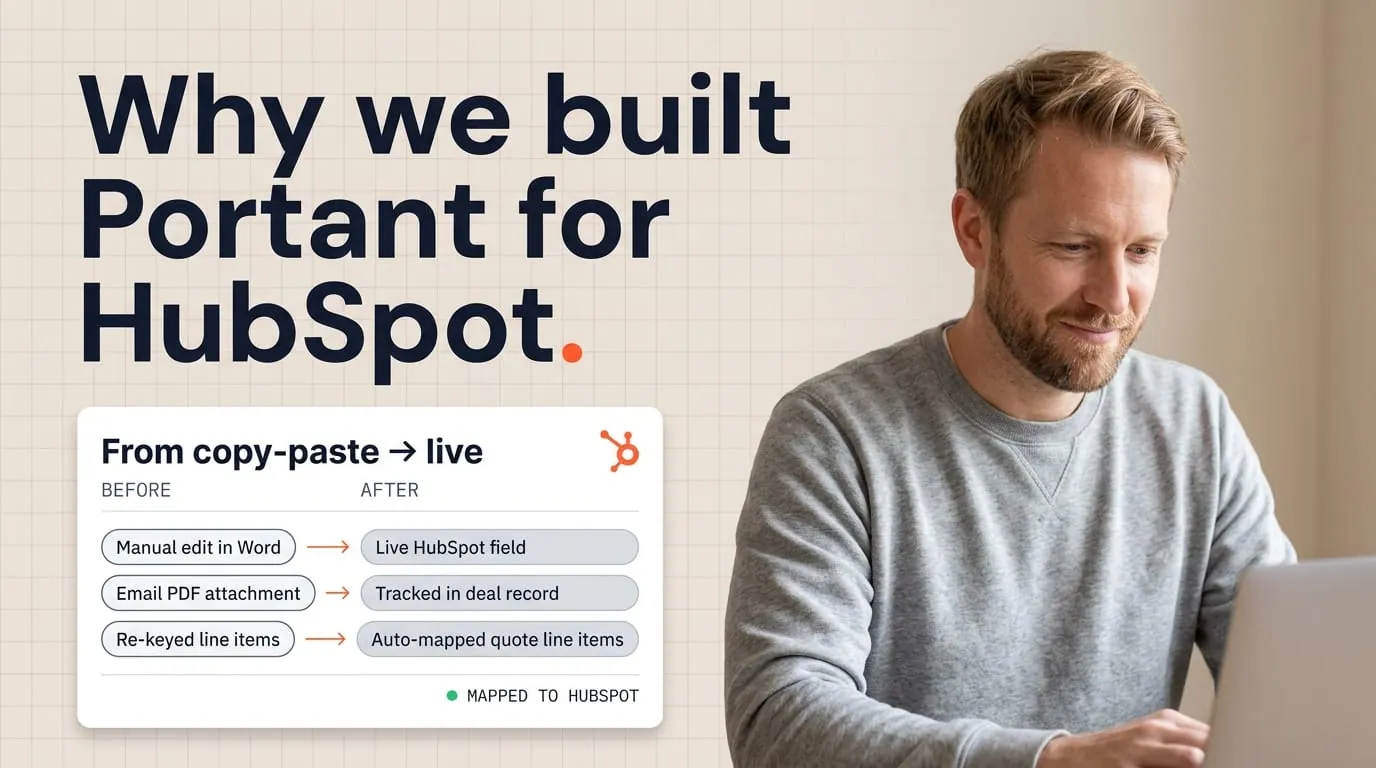
Every growth stage company eventually hits the same wall. HubSpot becomes the source of truth for the pipeline, but the documents that actually close deals live somewhere else. Reps copy deal fields into Google Docs, fix formatting by hand, then try to remember to update the CRM when something changes. It is exhausting, error prone, and completely normal until you decide it should not be.
We built Portant because that gap was not a small inconvenience. It was a structural drag on revenue. When paperwork is disconnected from the CRM, forecasts soften, legal gets surprises, and buyers feel friction right when you need speed.
For the full picture of how document generation, data merge and eSignature fit together in HubSpot, see the complete guide to document automation in HubSpot.
The pattern we saw everywhere
Before Portant, we watched the same playbook repeat. A team outgrows static PDFs, duct tapes HubSpot Quotes for a while, then graduates to a heavyweight eSign or CPQ tool that still treats the CRM as a data feed instead of the home for the sale.
Reps learn workarounds. Marketing ships beautiful brand guidelines that never quite reach the one off proposal a rep sends at quarter end. Leadership asks for visibility into “where the contract is,” and nobody has a clean answer.
We believed there was room for a product that respected how HubSpot teams actually work: live deal data, familiar templates in Google or Microsoft formats, and a full path to signature without inventing a parallel universe of records.
Why HubSpot, not “generic CRM”
HubSpot’s ecosystem rewards apps that go deep on objects, workflows, and marketplace trust. Teams want an integration that is certified, maintained, and obvious to onboard, not a custom Zap that breaks when someone renames a field.
We invested in being the number one HubSpot certified document automation app because depth beats breadth here. Thousands of sales teams, 920,000+ users, and 5.1M+ documents automated later, the bet is still that HubSpot first beats CRM agnostic shallow connectors.
What we refused to build
We did not want another siloed editor that asks you to retrain the company on proprietary layout tools. We did not want a future where “the deal is in HubSpot but the truth is in someone’s cloud drive.”
Portant meets teams where their templates already live, merges HubSpot properties and line items accurately, and writes document state back to the deal. Compare us to point solutions anytime; see Portant vs PandaDoc for a feature level view.
The outcome we optimize for
The metric that matters is time returned to selling and the reduction in revenue leaks from wrong numbers on customer facing paper. Teams report saving around 125 hours per month and meaningful cost avoidance when automation replaces manual assembly.
That is not magic. It is what happens when generation takes one click, approvals have a path, and signatures sync to the timeline leadership already watches.
Where we are heading
We continue to tighten the loop between CRM data, AI assisted drafting where it helps, and guardrails that keep humans in charge of what goes out the door. If you are evaluating document automation, start with the workflow you run today, map the copy paste steps, and ask whether your next tool eliminates them, or moves them somewhere else.
We built Portant to eliminate them. Everything else is secondary.
Frequently asked questions
Is Portant only for enterprise teams?
No. Small teams adopt quickly because the value is removing manual document assembly, which hurts at every scale. Larger orgs add governance, approvals, and template libraries on top of the same core.
Do we need developers to get started?
No developer should be required for standard merges from HubSpot into Docs or Word templates. Complex custom objects and branching logic may need ops time, but the first workflow should be approachable for a savvy admin.
Why not just use native HubSpot quotes?
Native quoting works for many early use cases. Teams tend to outgrow it when they need richer branding, multi document lifecycles, or deeper automation. Portant extends what HubSpot starts without asking you to leave the portal.